Coloring should not feel like another task that needs to be completed perfectly.
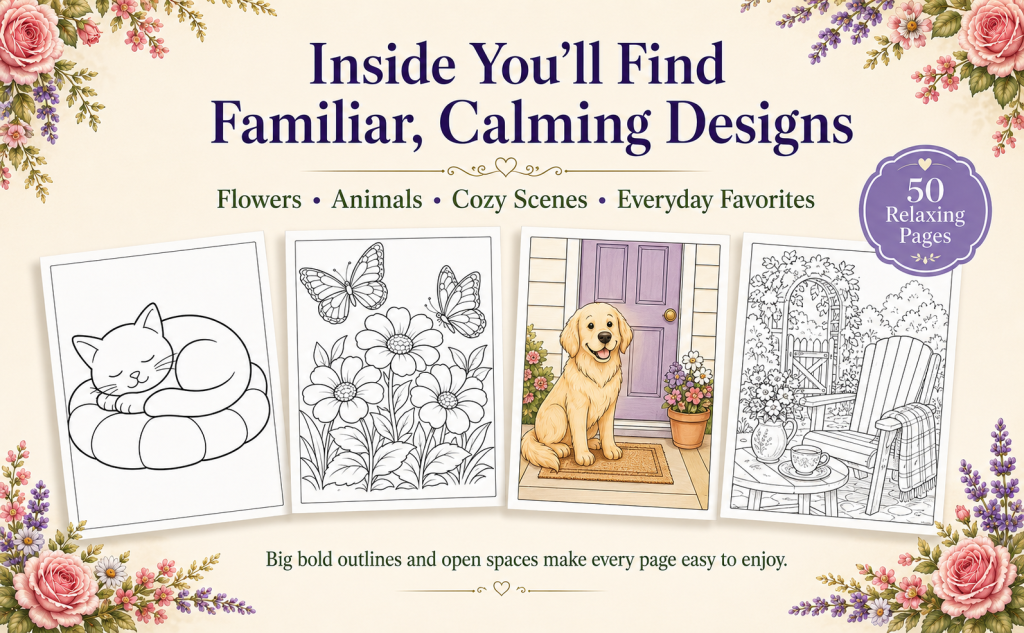
Sometimes, the most enjoyable pages are the ones that feel immediately familiar: a sleeping cat, a friendly dog, a flower in a vase, a quiet garden, or a comfortable chair waiting on the porch.
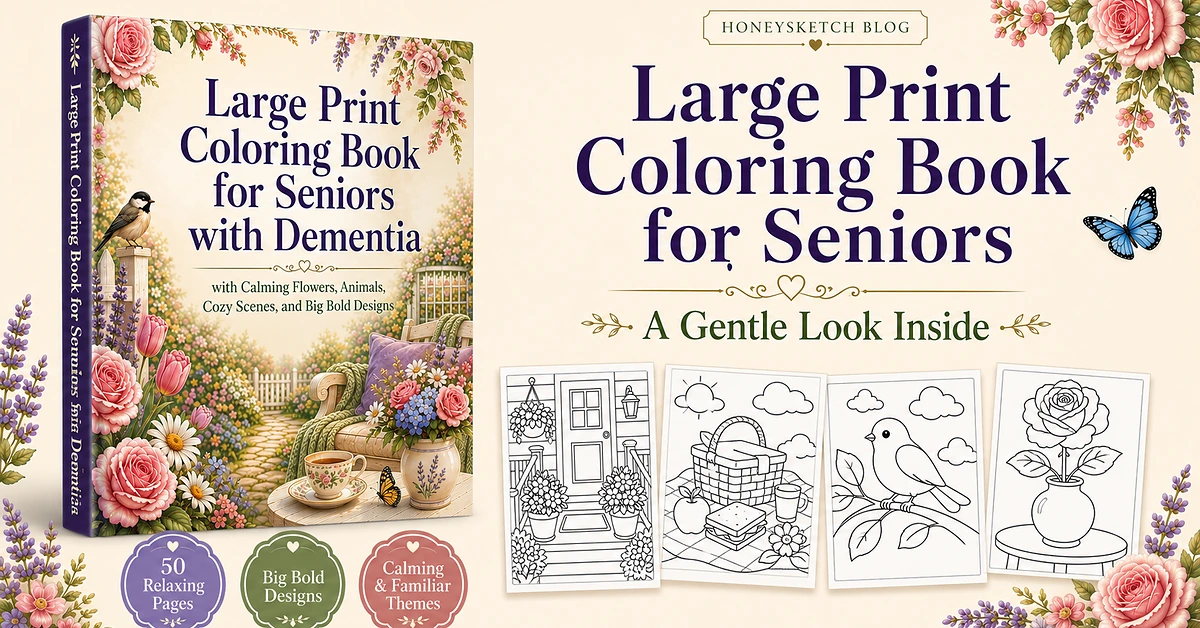
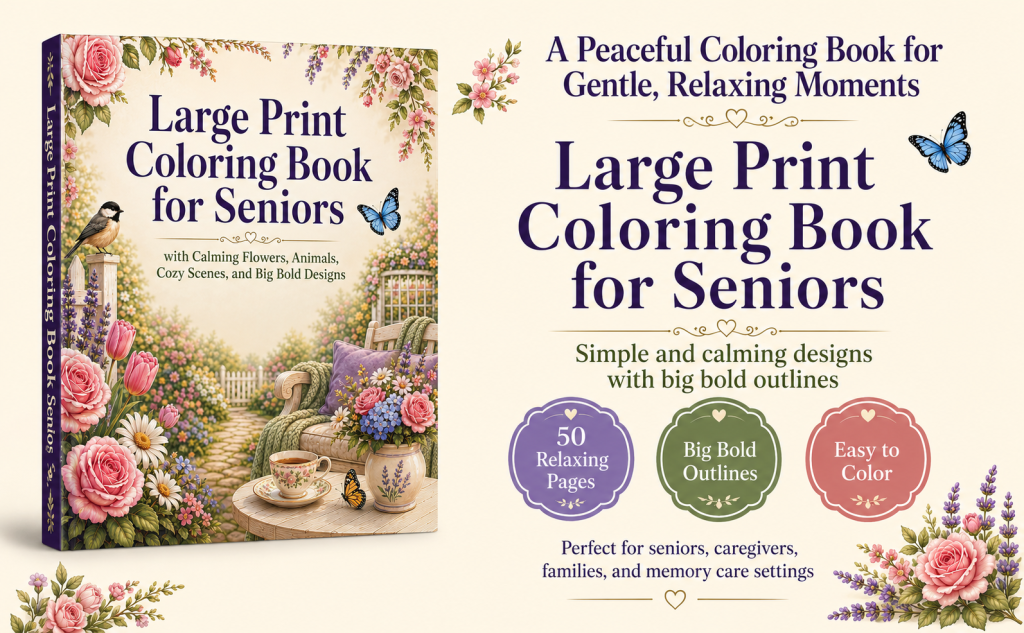
That gentle sense of familiarity inspired this large print coloring book for seniors with dementia. Instead of tiny patterns and crowded illustrations, the book includes clear subjects, bold outlines, open spaces, and a thoughtful range of difficulty levels.
Some pages are very easy. Others provide a little more detail for anyone who enjoys taking extra time with a picture. There is no correct page to choose and no pressure to complete an entire design in one sitting.
The images in this article are preview pages from HoneySketch’s Large Print Coloring Book for Seniors.
What makes a coloring page comfortable for seniors?
Many adult coloring books are filled with tiny shapes, complicated patterns, and narrow areas. These designs may be enjoyable for some people, but they can feel frustrating to someone who prefers clearer, more open illustrations.
A senior-friendly coloring page may feel more approachable when it includes:
- large and recognizable subjects
- clear, bold outlines
- generous open spaces
- familiar flowers, animals, and household scenes
- limited visual clutter
- a choice between easy and more detailed designs
The purpose is not to remove every detail. It is to offer enough variety that the colorist can choose a page that matches their interest, vision, energy, and comfort level that day.
Also check to see: “Axolotl Friendship Coloring Pages for Kids“
Different pages for different comfort levels

A very simple picture may feel perfect one afternoon. On another day, the same person may enjoy coloring a garden filled with flowers.
That is why the book does not use one difficulty level throughout all 50 pages.
The easiest designs have one main subject and large spaces. The intermediate pages add a simple background or a few supporting objects. The more detailed scenes include gardens, porches, flowers, paths, and familiar outdoor settings.
This variety also makes the book suitable for shared activity settings where several people may have different preferences.
1. A peaceful sleeping cat
A curled-up cat resting on a soft cushion is one of the simplest pages in the book.
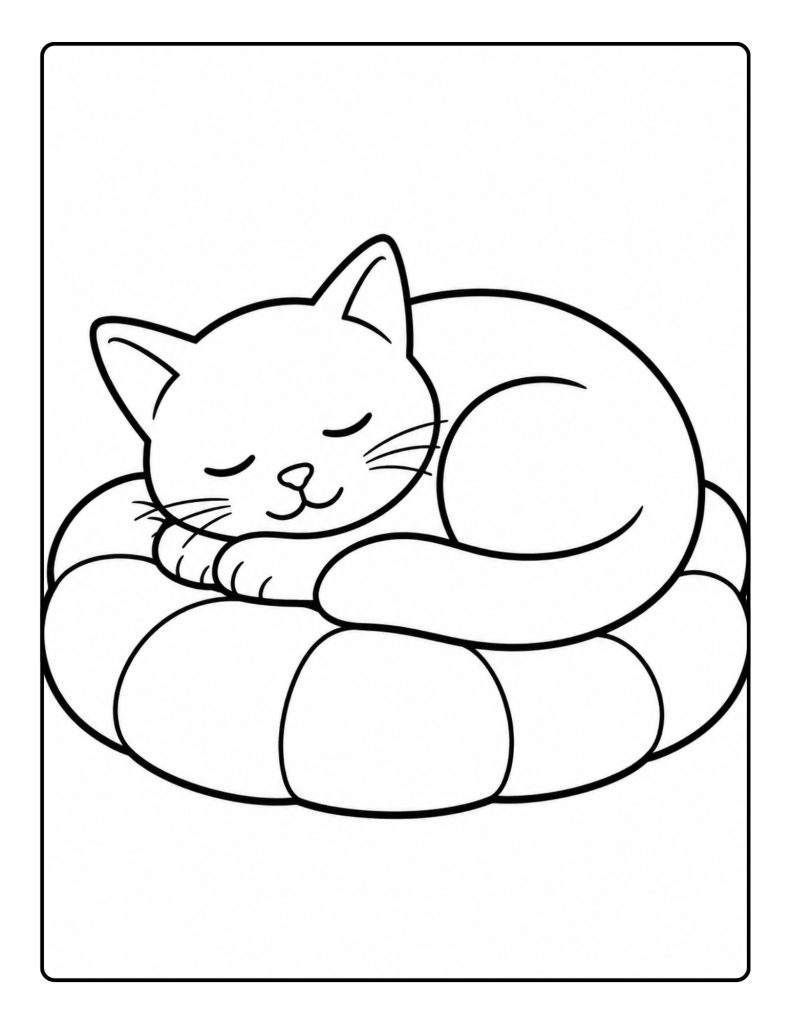
The design contains a few large areas rather than dozens of tiny sections. The cat’s body, tail, face, and cushion are separated by strong, easy-to-follow outlines.
This can be a comfortable first page for someone who is unsure where to begin.
Color ideas for the sleeping cat
The cat could be colored:
- warm orange with a cream-colored face
- soft gray with a blue cushion
- pale brown with a dusty rose cushion
- black and white with a lavender cushion
- cream with a sage green cushion
There is no need to use realistic colors. A purple cat or a bright pink cushion can be just as enjoyable.
For an especially simple approach, choose only two or three colors for the entire page.
2. A friendly dog waiting by the door
The friendly dog page introduces a few more areas while keeping the main subject easy to recognize.
The dog sits on a mat beside a flowerpot and a familiar front door. The scene feels cheerful without including too many small background elements.
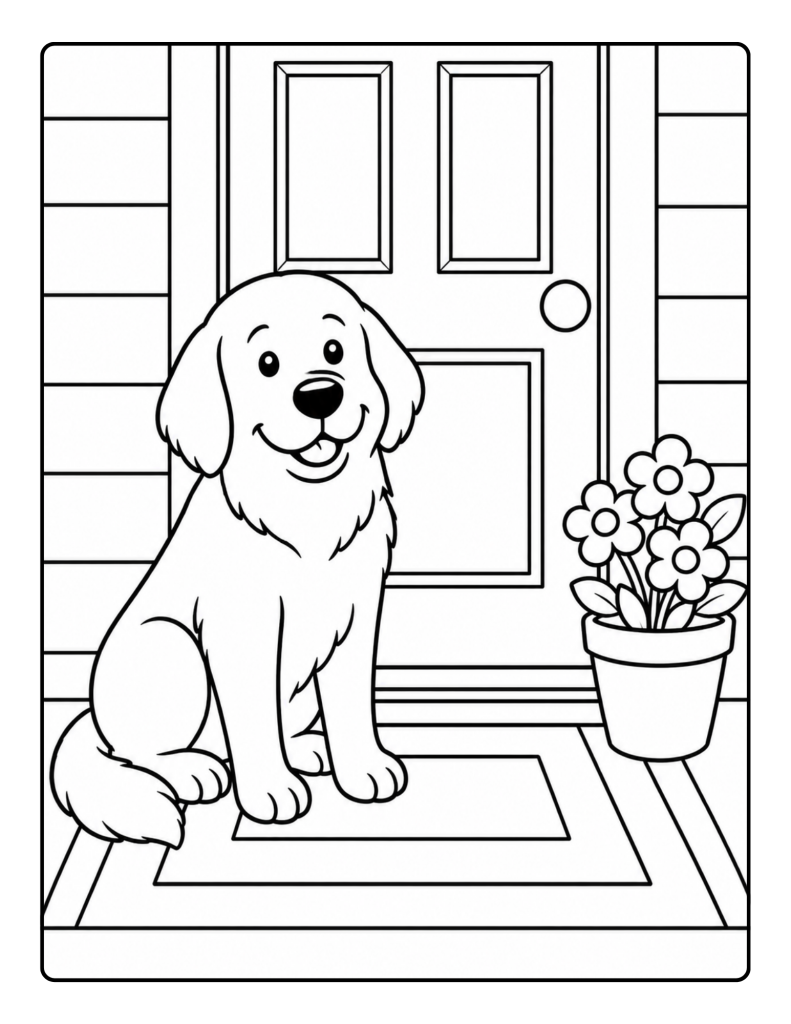
Color ideas for the dog page
Try using:
- golden yellow or light brown for the dog
- purple, blue, red, or forest green for the door
- terracotta or beige for the flowerpot
- pink and yellow for the flowers
- tan, rust, or soft gray for the mat
The door can also be colored to resemble a familiar home. A caregiver or family member might casually ask, “What color would you choose for the door?” rather than directing the person toward a particular answer.
A shared coloring activity should feel like an invitation, not a test.
3. A single rose in a vase
A single rose creates a strong focal point without making the page feel empty.
The petals add enough variety to keep the design interesting, while the large vase and leaves provide broad spaces that can be filled comfortably.

Color ideas for the rose
A rose does not always need to be red. Consider:
- blush pink petals with dark green leaves
- peach petals with sage green leaves
- yellow petals with an aqua vase
- lavender petals with a cream vase
- deep red petals with a pale blue vase
- white petals outlined with light gray or pale pink
For gentle shading, use a slightly darker version of the main color near the bottom of each petal. Shading is entirely optional. Flat, solid colors can look just as beautiful.
Why familiar subjects can make coloring easier to begin
A familiar image gives the colorist an immediate visual starting point.
A person may already have an idea of how they would like to color a rose, cat, dog, chair, or garden. They do not need to understand an abstract pattern before beginning.
Familiar subjects may also encourage relaxed conversation.
A flower page might inspire a discussion about favorite flowers. A porch scene might bring up gardening, morning tea, or comfortable outdoor chairs. A dog page might lead to a story about a beloved pet.
These conversations should develop naturally. The purpose is not to check whether someone remembers a name, date, or event correctly.
4. A peaceful porch and rocking chair
The porch page includes more detail than the sleeping cat or single rose, but every object remains recognizable.
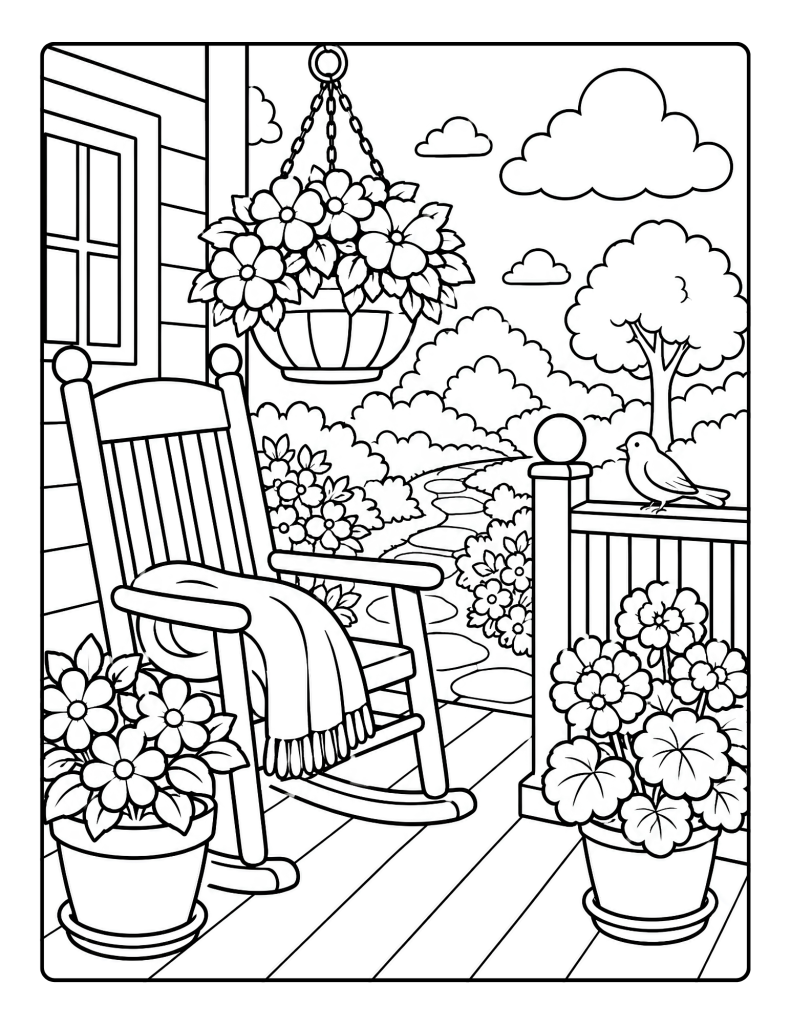
The scene includes:
- a rocking chair
- a folded blanket
- flowerpots
- a hanging flower basket
- a small bird
- a porch railing
- a path leading through the garden
The page can be colored all at once or divided into smaller sections.
Someone might color the chair today, the flowers tomorrow, and the garden path another afternoon. A coloring page does not need to be completed in one session.
You might also like: “Familiar Everyday Coloring Pages“
Color ideas for the porch scene
For a soft cottage palette, try:
- sage green
- dusty rose
- lavender
- warm cream
- pale brown
- muted blue
For a brighter garden palette, try:
- coral
- sunflower yellow
- sky blue
- leafy green
- violet
- warm red
The blanket on the chair can include two or three alternating colors. The flowerpots can match or each one can have a different color.
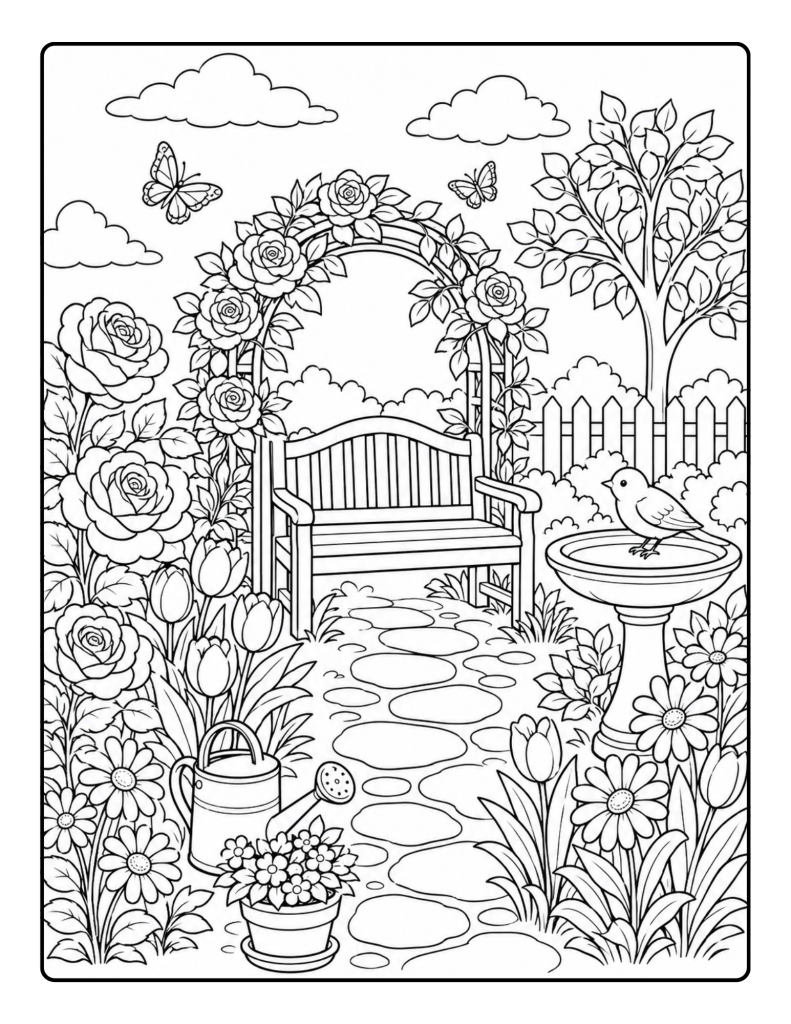
5. A garden bench beneath a rose arch
The garden bench page is one of the more detailed designs shown in this preview.
It includes a rose-covered arch, bench, birdbath, watering can, flowers, trees, fence, and stepping-stone path.
This page may suit someone who enjoys spending more time on a picture or coloring one small section at a time.
An easy way to approach a detailed page
A detailed page can look less overwhelming when it is divided into simple steps.
Start with one area:
- Color the bench.
- Choose one color for the roses.
- Add green to the leaves.
- Color the bird and birdbath.
- Finish with the path and background.
The colorist can stop after any step. Completing only the bench and a few flowers is still a finished creative session.
How caregivers can offer the book without creating pressure
The way an activity is introduced can matter as much as the activity itself.
Instead of placing the entire book and a large container of supplies on the table, begin with two or three page choices.
For example, offer:
- one simple animal page
- one flower page
- one familiar outdoor scene
Then provide a small selection of crayons or colored pencils. Too many colors can sometimes make the first decision harder, so beginning with six to twelve colors may feel more manageable.
A caregiver can also sit nearby and color a separate page. Quietly participating often feels more natural than repeatedly explaining what to do.
If the person is not interested, becoming tired, or showing frustration, put the activity aside. The page can be offered again on another day.
Choosing comfortable coloring supplies
Different tools create different experiences.
Crayons
Crayons are familiar, easy to replace, and available in thick varieties that may be more comfortable to hold.
Colored pencils
Colored pencils provide more control and work well for pages with a mixture of large and moderately detailed spaces.
Markers
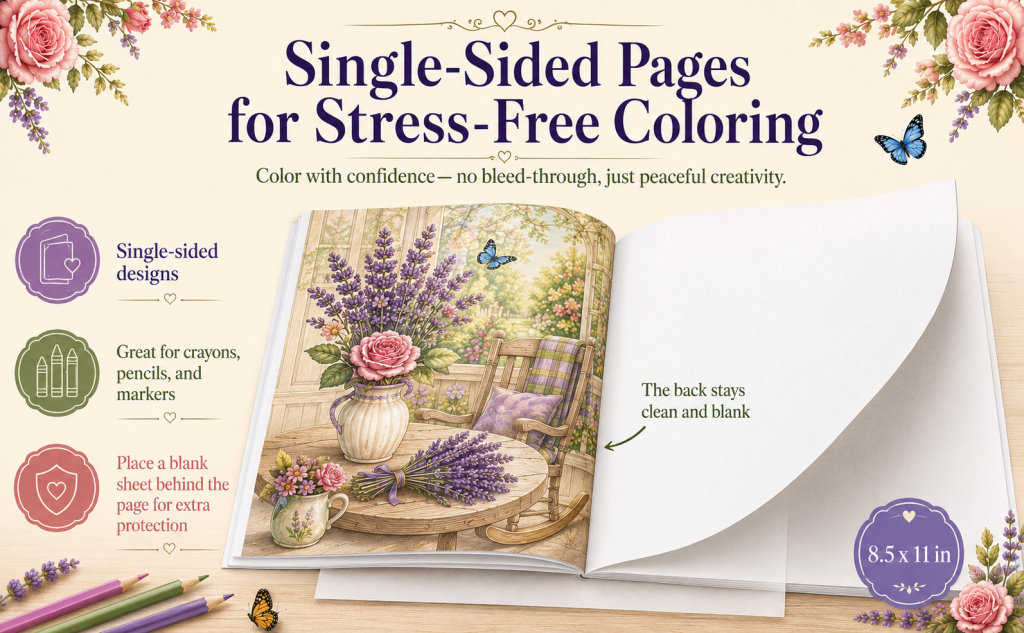
Markers create bright color without requiring as much pressure. Because paper and markers vary, place a blank protective sheet behind the page before coloring.
The book uses single-sided designs, so every coloring illustration has a blank reverse side. The protective sheet adds another layer between the current page and the next design.
Who may enjoy this coloring book?
This book may be suitable for:
- seniors who prefer large, easy-to-see coloring designs
- older adults who find highly detailed adult coloring books tiring
- people living with dementia or Alzheimer’s who already enjoy creative activities
- grandparents and elderly parents
- caregivers looking for a peaceful shared activity
- assisted living activity programs
- memory care settings
- beginners who prefer bold outlines
- adults with limited vision who find tiny patterns difficult to see
- anyone who enjoys flowers, pets, gardens, and cozy scenes
Every individual is different. Some people love coloring, while others prefer music, conversation, puzzles, gardening, or another activity.
The book should be offered as an enjoyable option rather than used as a medical treatment or required exercise.
A simple coloring routine
A coloring session does not need complicated preparation.
Try this simple routine:
- Choose a quiet, well-lit place.
- Offer two or three page options.
- Place a small number of colors within comfortable reach.
- Let the colorist choose where to begin.
- Avoid correcting color choices.
- Pause whenever the person appears tired.
- Display or photograph the finished page if they would enjoy that.
There is no minimum amount of time that someone needs to color. A few peaceful minutes can be enough.
Final thoughts
A meaningful coloring experience does not depend on complicated artwork or perfect results.
It can begin with something as simple as choosing a favorite color for a rose, filling in a soft cushion beneath a sleeping cat, or adding cheerful flowers beside a familiar front door.
The bold outlines and recognizable subjects in this book are designed to help each page feel clear and inviting. The mixture of easy and more detailed illustrations also allows the colorist to choose what feels comfortable in the moment.
Like this style of peaceful coloring page? You can find more flowers, friendly animals, cozy scenes, and familiar designs in the complete paperback.
Disclosure:
This post may feature HoneySketch books or products. If you purchase one of our books through a link on this page, HoneySketch may earn royalties or income from that sale at no extra cost to you.
Frequently asked questions
Is this coloring book only for seniors with dementia?
No. The book can also be enjoyed by seniors, older adults, beginners, caregivers, grandparents, and anyone who prefers clear designs with bold outlines and open spaces.
Are all coloring pages extremely simple?
No. The book contains a range of designs. Some pages are very easy, while others contain flowers, gardens, and familiar scenes with a little more detail.
Can markers be used?
Markers can be used, but results depend on the marker and paper. Place a blank sheet behind the page to help protect the next design.
Are the pages single-sided?
Yes. Each coloring design is printed on one side of the page, with a blank reverse side.
Does coloring treat Dementia or Alzheimer’s disease?
No. This is a creative activity book, not a treatment, diagnostic tool, or replacement for professional medical care.
Does every page need to be completed?
Not at all. The colorist can finish one small section, return to the page later, or simply enjoy the time spent choosing and applying colors.