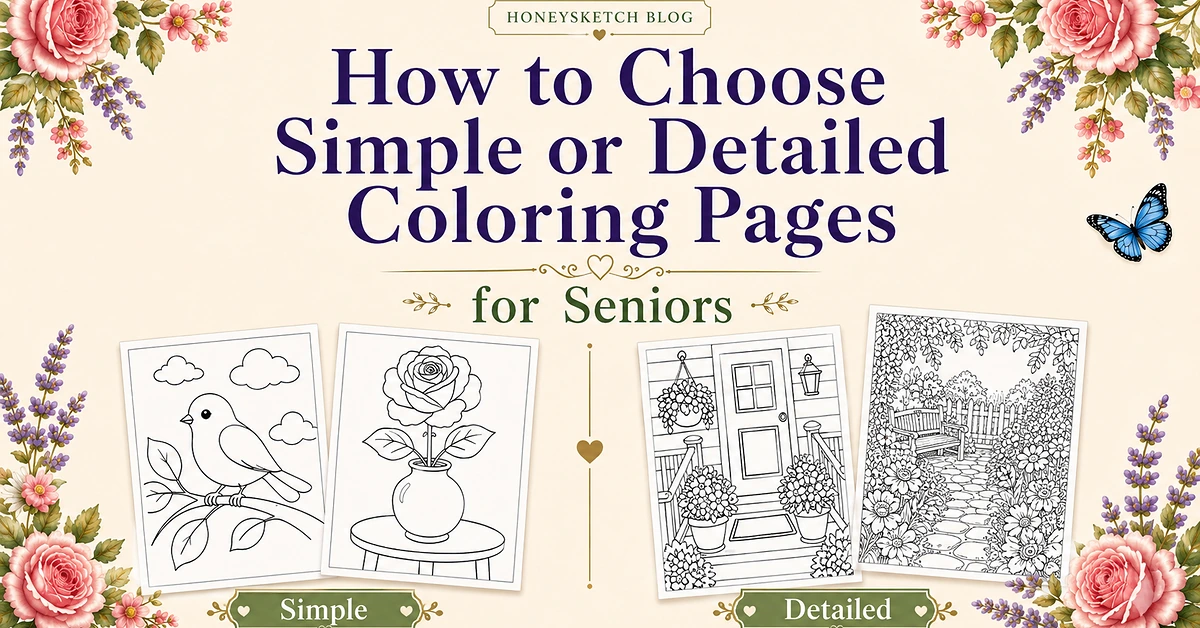
The best coloring page is not always the easiest page or the most beautiful page in the book.
It is the page that feels comfortable and inviting at that particular moment.
A senior may enjoy coloring a detailed flower garden one afternoon and prefer a single sleeping cat the next morning. Interest, energy, vision, patience, hand comfort, and available time can all affect which design feels enjoyable.
That is why a coloring book with only one difficulty level may not suit every session.
The HoneySketch Large Print Coloring Book for Seniors includes pages ranging from very easy designs to fuller scenes with flowers, animals, gardens, porches, and familiar objects.
Here is how to decide which type of page may be the best place to begin.
Simple and detailed pages can both be relaxing

A simple page is not automatically better for every senior.
Some people enjoy large, open shapes because they can color without making many decisions. Others prefer scenes with several objects because they like choosing different colors and working on a picture over multiple sessions.
The goal is not to assign a skill level.
Instead, consider what feels enjoyable today.
A simple design may be useful when someone:
- wants a shorter activity
- feels tired
- prefers fewer choices
- finds small details uncomfortable
- wants to finish a page in one sitting
- enjoys large, bold subjects
A more detailed design may be appealing when someone:
- wants a longer creative activity
- enjoys flowers, gardens, or scenery
- likes using several colors
- prefers working section by section
- wants to return to the same page later
- enjoys pictures with a story or setting
Neither option is more valuable than the other.
Very easy pages with one main subject
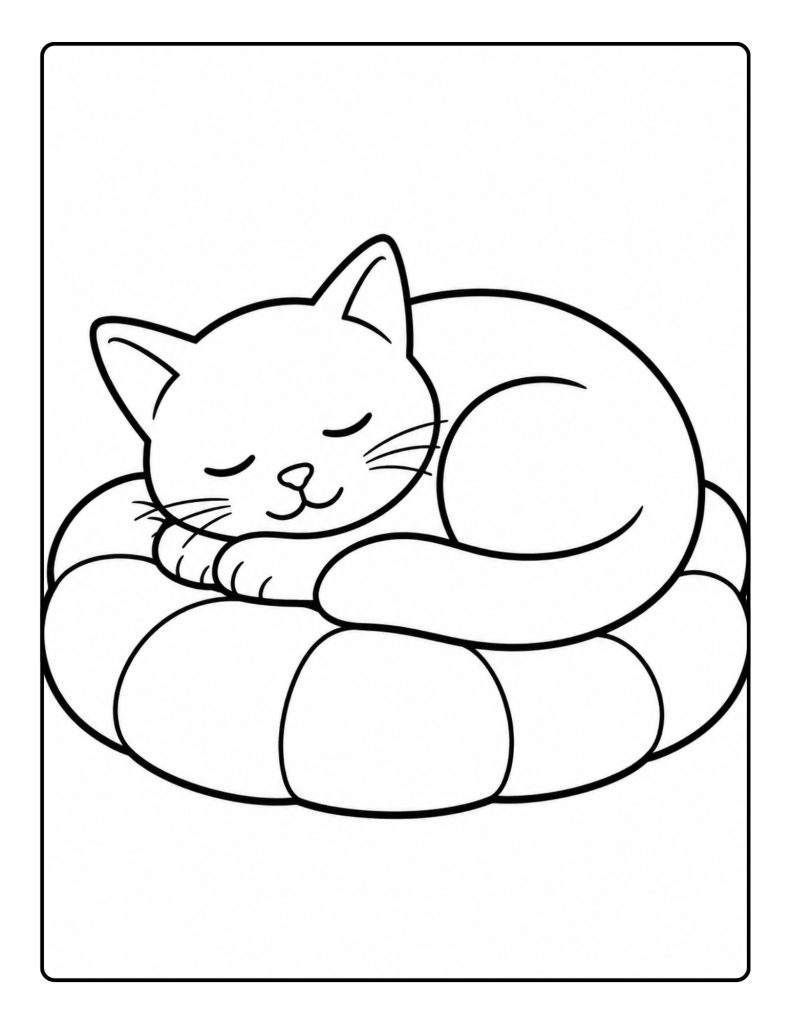
The simplest coloring pages usually contain one large subject and little or no background detail.
Examples include:
- a sleeping cat
- one bird on a branch
- a large flower
- a butterfly
- one animal in an open setting
These pages provide an obvious starting point.
The colorist can choose one color for the main subject and another for the supporting object. The entire page may require only two to five colors.
A sleeping cat on a cushion is a good example. The cat, tail, face, paws, and cushion are all separated by clear outlines, but the design does not contain a detailed room or garden behind it.
When a very easy page may work well
Choose a very easy design when:
- the person wants to color for only a few minutes
- making many color choices feels tiring
- the person is new to coloring
- the hands or eyes feel tired
- a crowded page feels frustrating
- the person wants a page that looks approachable immediately
The page does not need to be completed. Coloring only the cushion or the cat can still create an enjoyable session.
Simple pages for shorter coloring sessions
A simple page may contain one large subject and a few supporting shapes.
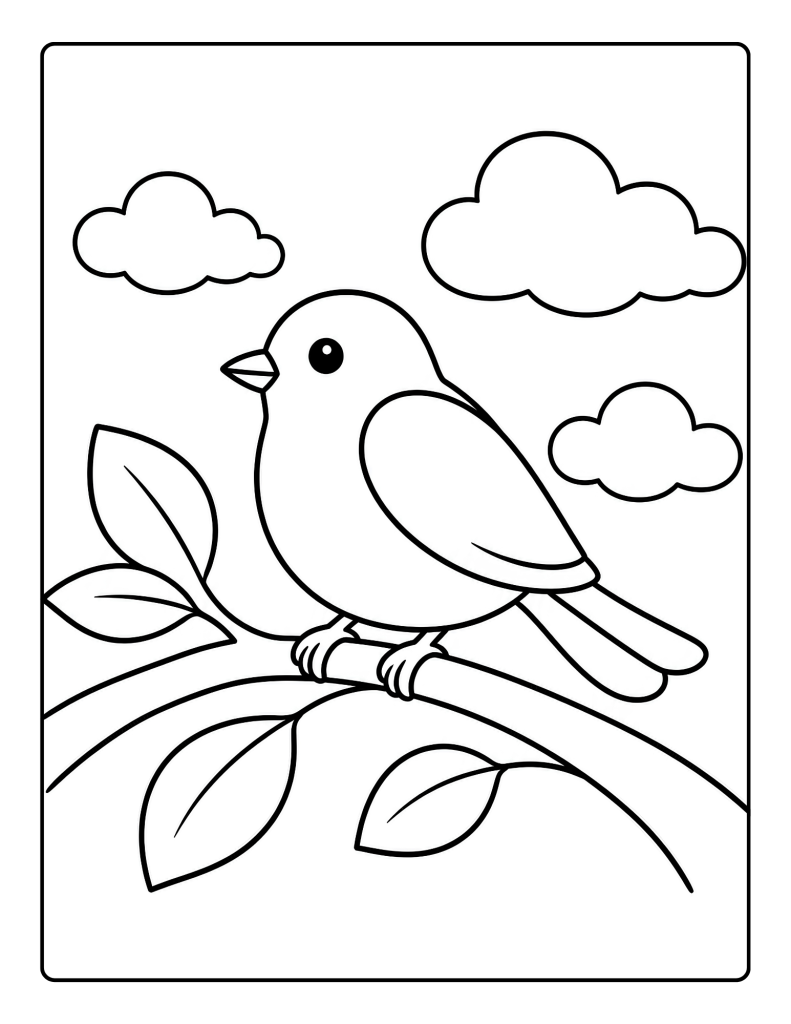
A bird on a branch, for example, includes the bird, wing, beak, tail, branch, leaves, and clouds. There is more variety than the sleeping cat page, but the overall design remains open and uncluttered.
This type of page can be useful when someone wants a little more choice without committing to a full scene.
The complete HoneySketch paperback includes 50 single-sided designs ranging from very easy animals and flowers to fuller gardens, porches, and familiar everyday scenes.
The complete HoneySketch paperback includes 50 single-sided designs ranging from very easy animals and flowers to fuller gardens, porches, and familiar everyday scenes.
A simple way to color the bird page
Choose:
- one color for the bird’s body
- one color for the wing
- brown or gray for the branch
- green for the leaves
- blue or pale gray for the clouds
The page can also be completed using only three colors.
Relaxing pages with familiar background details
The next level includes one main subject plus a simple and recognizable setting.
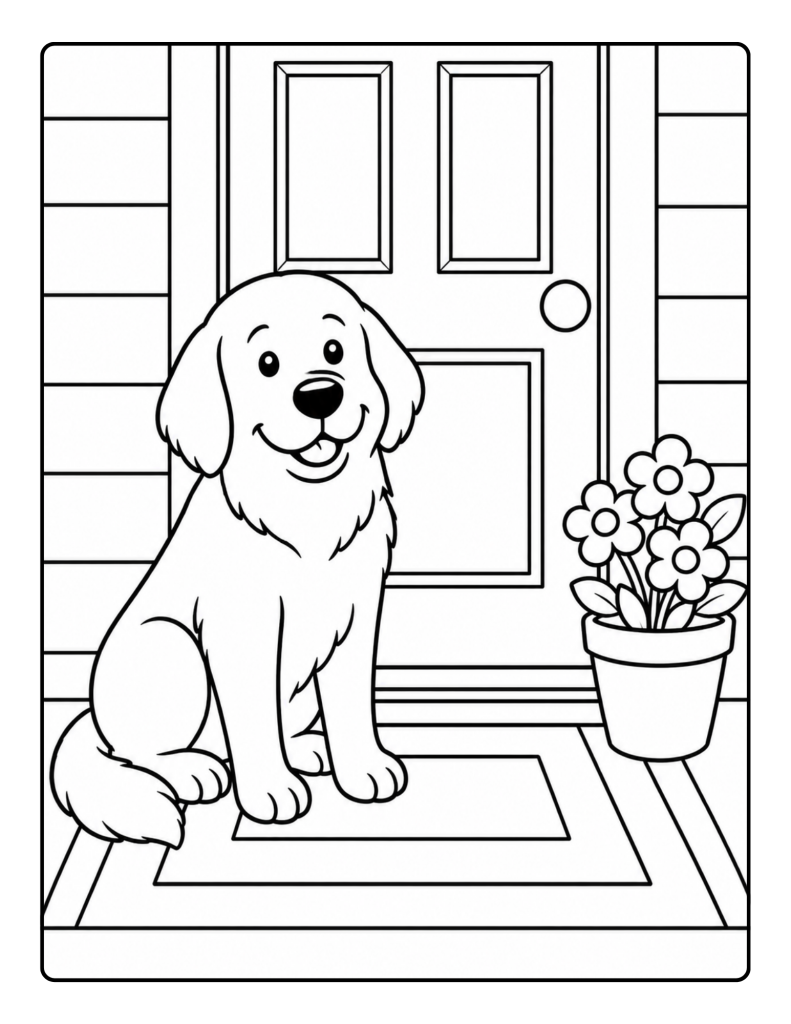
A friendly dog beside a front door is a good example.
The dog remains the focus, but the colorist can also work on:
- the door
- flowerpot
- mat
- flowers
- porch boards
This type of page provides more variety while keeping every object familiar.
Who may enjoy a relaxing intermediate page?
It may suit someone who:
- finds one-object pages too empty
- likes home and pet scenes
- enjoys choosing several colors
- wants a picture that can be completed in stages
- prefers recognizable subjects over abstract patterns
The dog can be colored first. The door and flowerpot can be saved for another time.
Moderate pages with several separate objects
A moderate coloring page may include several objects that are easy to identify and color independently.

The picnic page includes:
- a picnic basket
- sandwich
- apple
- cup
- flower
- checked blanket
- sun
- clouds
Although there are several elements, the page does not feel highly detailed because each object has broad, open shapes.
Why separate objects can make a page easier
A scene with several clearly separated objects gives the colorist choices.
Someone can begin with the basket, food, flower, or blanket. There is no single required starting point.
The page can also be divided into short sessions:
Session one: Color the basket and blanket.
Session two: Color the apple, sandwich, and cup.
Session three: Add the flower, sky, sun, and clouds.
Explore Simple and Detailed Designs
Detailed pages for longer creative sessions
Detailed pages include more objects, flowers, leaves, textures, or background features.
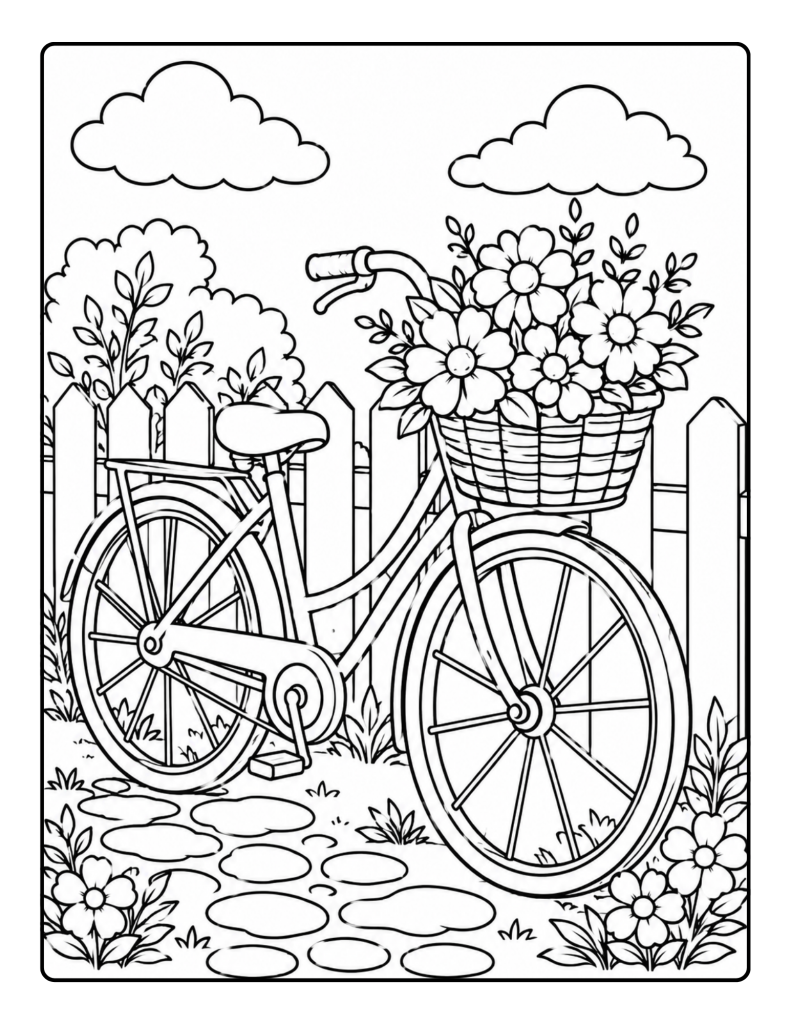
A bicycle beside a garden fence may include:
- two large wheels
- bicycle frame
- handlebars and seat
- flower basket
- picket fence
- garden plants
- stepping stones
- clouds
At first glance, a page like this may appear more demanding than a sleeping cat. However, it does not need to be completed all at once.
The bicycle can be treated as one small project. The flowers can become another. The fence and path can be completed last.
When a detailed page may be a good choice
A more detailed page may suit someone who:
- enjoys longer activities
- likes gardens and familiar outdoor scenes
- wants to use many colors
- enjoys returning to the same picture
- prefers having several areas to choose from
- finds very simple pages less interesting
The person can stop after any section.
How to make a detailed page feel more manageable
A detailed page becomes easier when it is divided into smaller visual groups.
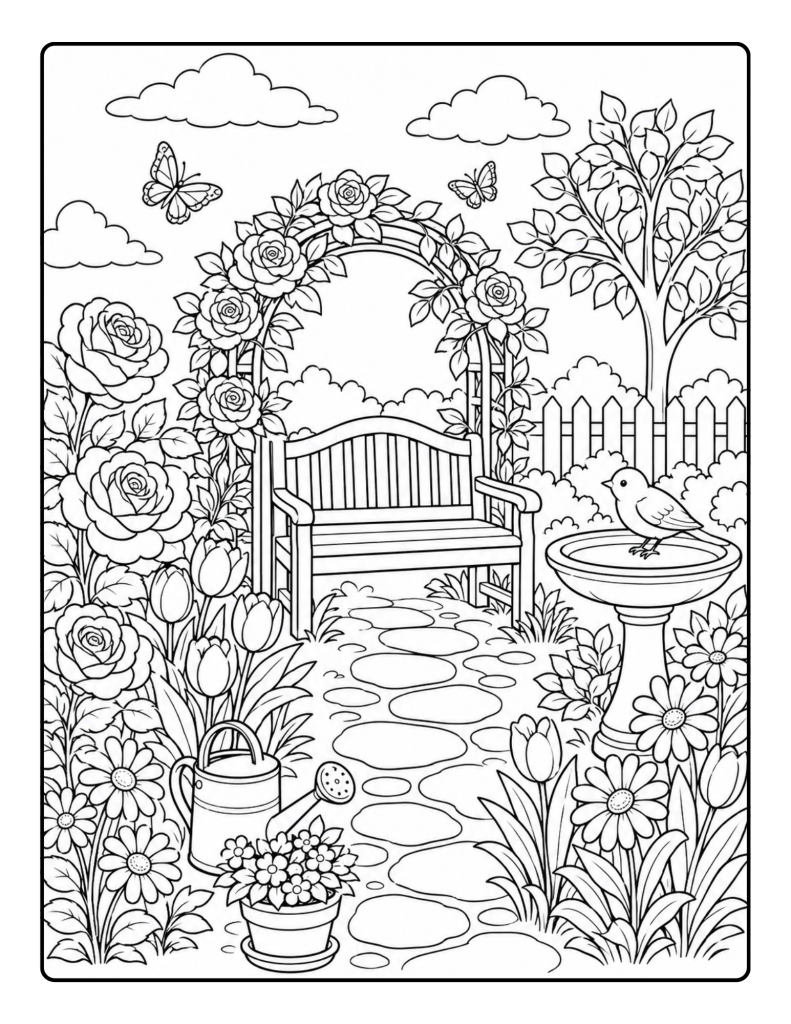
A garden scene may include a bench, rose arch, birdbath, flowers, watering can, fence, and path.
Instead of looking at the whole page as one project, choose one section.
Step 1: Find the largest object
Begin with the bench, bicycle, flower cart, or chair.
Large objects often contain the broadest spaces and provide a clear place to start.
Step 2: Choose a limited color palette
Select four to six colors before beginning.
For a garden scene, try:
- dusty pink
- lavender
- sage green
- warm brown
- pale blue
- cream
Repeating these colors throughout the page creates a coordinated result and reduces the need to make constant decisions.
Step 3: Color similar objects together
Color all roses with one palette.
Color all leaves with one or two greens.
Use the same brown for the bench, fence, or path when appropriate.
Step 4: Leave the background until later
The main objects often provide enough color to make the page feel complete.
The sky, ground, fence, and distant trees can remain white until the person feels ready to continue.
Step 5: Stop at a natural point
A natural stopping point might be:
- after finishing the bench
- after coloring all large flowers
- after completing the bicycle
- after filling the foreground objects
The page can be saved for another session.
Consider the person’s interest before the difficulty level
A supposedly easy page may not feel inviting when the subject does not interest the colorist.
Someone who loves gardening may prefer a detailed rose garden over a simple animal. Someone who loves pets may choose a dog or cat even when another page has fewer lines.
Before selecting a page, consider:
- favorite animals
- favorite flowers
- interest in gardening
- enjoyment of country scenes
- preference for homes and porches
- favorite seasons
- interest in birds or butterflies
- preference for simple objects
Interest can make a more detailed page feel easier to begin.
Consider how much time is available
A short session may work well with:
- one flower
- sleeping cat
- bird on a branch
- butterfly
- simple turtle
A longer session may work well with:
- porch and rocking chair
- bicycle and flower basket
- farmhouse
- garden bench
- flower cart
- rose-covered arch
The page can always be continued later, so time should guide the choice rather than limit it completely.
Consider visual comfort
Many adult coloring books use thin lines and tiny spaces.
A large print coloring book should use clear outlines and recognizable shapes, but some pages will naturally contain more sections than others.
When choosing a page, look at:
- line thickness
- size of the smallest spaces
- amount of white space
- contrast between the lines and paper
- number of overlapping objects
- visual clutter around the main subject
A page that looks beautiful in a preview may still feel too busy for a particular person.
Offer another option without making the person feel that they failed.
Consider hand comfort
Broad spaces may be easier for someone who prefers sweeping motions with a crayon or marker.
Smaller sections may be enjoyable for someone who likes using colored pencils and has comfortable control of the tool.
The choice of supplies can also change how difficult a page feels.
Crayons
Crayons work well for large spaces and simple pages.
Colored pencils
Colored pencils provide control for flower petals, bicycle parts, leaves, and smaller objects.
Markers
Markers provide bright coverage without requiring heavy pressure. Place a blank protective sheet behind the page.
The HoneySketch book uses single-sided designs, but a protective sheet can help guard the next page.
Offer choices without showing the entire book
Opening a book to 50 designs may create too many options at once.
Instead, select three pages:
- one very easy design
- one relaxing intermediate design
- one more detailed scene
For example:
- sleeping cat
- dog by the door
- bicycle with flowers
Ask which one looks most enjoyable.
This gives the person control without requiring them to compare every page.
A simple three-page choice system
Use this approach before each coloring session.
Choice 1: Very easy
One large animal or flower with plenty of open space.
Choice 2: Relaxing
One main subject with a simple background.
Choice 3: More detailed
A garden, porch, farm, or outdoor scene with several objects.
The person may surprise you by choosing a different level each time.
Avoid labeling pages as too easy or too difficult
Words can affect how an activity feels.
Instead of saying:
- “This one is too hard for you.”
- “You should start with the easiest page.”
- “That page has too much detail.”
- “You will not finish this one.”
Try:
- “Which page looks nicest today?”
- “Would you like one big picture or a fuller scene?”
- “Do you feel like coloring an animal or a garden?”
- “We can color one part and save the rest.”
- “You can change pages whenever you like.”
The goal is to preserve choice and enjoyment.
Who may benefit from a book with varied page styles?
A coloring book with mixed difficulty levels may work well for:
- seniors whose energy changes from day to day
- older adults who enjoy different subjects
- caregivers supporting more than one person
- assisted living activity groups
- memory care settings
- families coloring together
- beginners who want to try more detail gradually
- experienced colorists who still prefer bold outlines
- gift buyers who are unsure which difficulty level to choose
Variety allows the book to adapt to the moment.
Final thoughts
Choosing between a simple and detailed coloring page is not about deciding what someone is capable of completing.
It is about finding the design that feels most inviting today.
A sleeping cat may be perfect for a quiet ten-minute session. A bicycle with flowers may provide an enjoyable afternoon project. A detailed garden may become something the person returns to over several days.
Offering variety makes it easier to respect changing interests, comfort, and energy.
Frequently asked questions
Should seniors always begin with the easiest page?
No. The best starting page is the one that feels interesting and comfortable.
Can a detailed page be colored over several days?
Yes. A detailed page can be divided into sections and continued whenever the person feels interested.
What should I do when the page feels overwhelming?
Offer a simpler page or cover part of the design with blank paper so only one section is visible.
How many colors should be offered?
Begin with six to twelve colors. More can be added when the person wants additional choices.
Is it necessary to color the background?
No. The main subject can be colored while the background remains white.
Does the person need to finish every single page?
No. A partially colored page is still a meaningful creative activity.
Disclosure:
This post may feature HoneySketch books or products. If you purchase one of our books through a link on this page, HoneySketch may earn royalties or income from that sale at no extra cost to you.